Lilacs are known for their beautiful spring blooms, but getting the timing right when pruning them is important. When to prune lilacs depends largely on their flowering cycle, because pruning at the wrong time can remove the buds that would produce next year’s flowers. In this guide, we’ll explain the best time to prune lilacs in Ontario, how to remove spent blooms and unwanted growth, and when an overgrown lilac may need more extensive rejuvenation pruning.
When to Prune Lilacs
The best time to prune lilacs is immediately after they finish flowering in spring. This gives the shrub time to produce new growth while avoiding the flower buds that will develop for the following year.

For most lilacs in Ontario, pruning should be done shortly after the spring flowers fade. The exact timing can vary with the weather and variety, so it’s better to watch the shrub than follow a specific date on the calendar.
Look for these signs that your lilac is ready:
Once flowering is over, you can remove spent blooms, dead or damaged branches, and selected older or poorly positioned stems without unnecessarily sacrificing next year’s flowers.
Why Timing Is So Important for Lilacs
Lilacs are different from many plants that can be pruned during their dormant season without affecting the next year’s bloom. They generally develop their flower buds for the following spring during the growing season after they finish flowering.
If you wait too long to prune, you risk cutting off those developing buds along with the branches you’re trying to remove. The shrub may look healthy and produce plenty of leaves, but you could end up with significantly fewer flowers the following spring.
For that reason, knowing when to prune lilacs is less about finding a particular date and more about working within the shrub’s flowering cycle.
Not Getting the Lilac Blooms You Expected?
SpinBlade can assess the shrub and help determine what may be affecting its growth, then recommend the right approach for its condition.
How to Prune Lilacs
Once flowering is finished, pruning lilacs can be approached in a few simple steps. The goal is to remove what the shrub no longer needs while preserving the healthy growth that will support future blooms.
How to Tell What Needs Pruning
Before making any cuts, take a step back and look at the entire shrub. The goal isn’t to remove as much as possible, but to identify growth that is actually creating a problem.
Start by looking for:
For routine maintenance, you generally won’t need to remove a large portion of the lilac. A few well-chosen cuts can do more good than repeatedly cutting back the whole shrub.
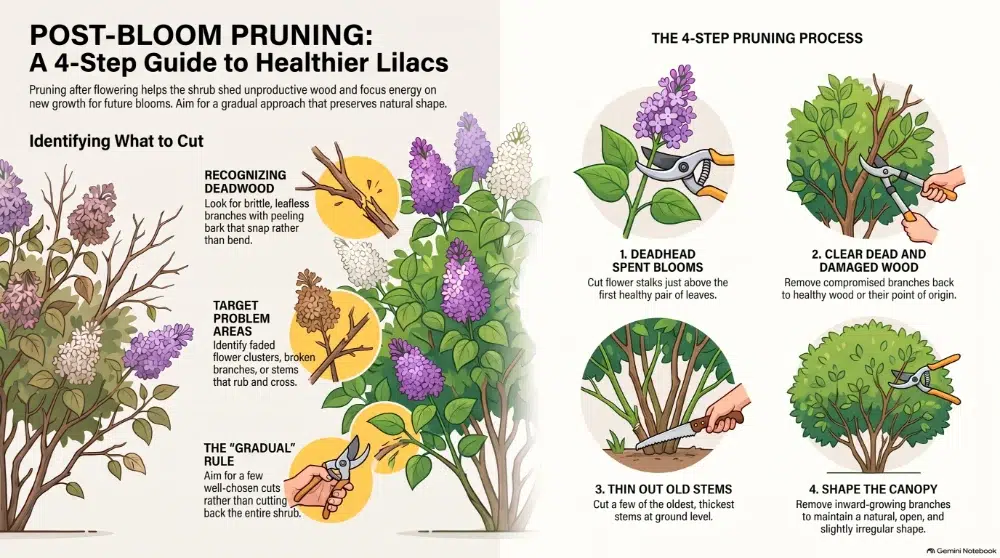
1. Start With Spent Blooms
Begin by removing the faded flower clusters. Look for blooms that have browned, dried out, or lost most of their petals.
Follow the flower stalk down to the first healthy pair of leaves or a suitable side branch, then make your cut just above it. This keeps the shrub tidy without unnecessarily removing larger sections of productive wood.
2. Look for Dead or Damaged Wood
Next, check the interior and lower portions of the shrub for branches that are completely dead, broken, diseased, or badly damaged.
Deadwood is easy to spot once you know what to look for: bare branches with no buds or leaves, peeling or damaged bark, and brittle wood that snaps rather than bends. Remove these branches back to healthy wood or to their point of origin where appropriate.
For larger or older lilacs, this is a good opportunity to incorporate deadwooding into your routine pruning.
3. Thin Out Some Older Stems
Lilacs naturally develop older, thicker stems at the base as they mature. Over time, these can crowd the shrub and contribute to a dense, woody appearance.
Instead of cutting the entire shrub back, remove a few of the oldest stems at ground level. This creates room for younger shoots to develop from the base and helps maintain a mix of younger and older growth.
Think gradual, not drastic: If your lilac has several old stems, you don’t necessarily need to remove them all in one season.
4. Shape the Shrub Without Overdoing It
Finally, step back and look at the lilac from several angles. Remove branches that cross, rub against one another, grow inward, or disrupt the shrub’s natural shape.
Avoid treating the lilac like a hedge that needs to be trimmed into a perfect ball. A slightly irregular, open shape is usually more appropriate than cutting everything back to create uniformity.
If the shrub is exceptionally dense, selective crown thinning may help open up the canopy, but the goal should still be to make targeted cuts rather than simply removing large amounts of healthy growth.
Light Pruning vs. Rejuvenation Pruning
Not every lilac needs the same level of pruning. A healthy shrub that is regularly maintained may only need a few selective cuts, while an old or neglected lilac may require a more deliberate approach to restore its structure.
Light Annual Lilac Pruning
For a lilac that is growing well and flowering normally, pruning can be relatively simple. Focus on removing only what is necessary:
The goal is to maintain the shrub rather than dramatically change its size or shape. If you can address the problem with a handful of well-placed cuts, there’s usually no reason to remove more.
Rejuvenation Pruning for Overgrown Lilacs
An old lilac that has become extremely tall, dense, or woody may need more than routine maintenance. You may notice fewer flowers, lots of thick old stems, bare growth toward the interior, or a shrub that has become difficult to manage.
Rejuvenation pruning focuses on gradually replacing old growth with younger stems. Rather than simply cutting the entire shrub down to a uniform height, remove some of the oldest stems at ground level to encourage new growth from the base.
For a severely overgrown lilac, this process may need to be spread out rather than trying to correct everything with one aggressive pruning session. The right approach depends on the shrub’s age, condition, size, and how much healthy growth remains.
Common Lilac Pruning Mistakes
Even when the timing is right, a few common pruning mistakes can leave lilacs looking worse or reduce their flowering in future seasons.
When in doubt, make fewer cuts and reassess the shrub’s shape as you go. You can always remove another branch later, but you can’t put one back.
When to Call a Professional
Most routine lilac pruning can be handled by a homeowner, but larger or severely overgrown shrubs can be more difficult to assess and prune safely.
Professional tree pruning may be worthwhile when:
Want Your Lilacs Looking Their Best Next Spring?
Proper timing and selective pruning can help protect future blooms while keeping your lilac healthy and well-structured. Let SpinBlade help you determine what your shrub needs.
Frequently Asked Questions
Still scratching your head? Here are quick answers to some of the most common questions people have.
In Short,
Knowing when to prune lilacs is just as important as knowing which branches to remove. For most lilacs, the safest approach is to prune shortly after spring flowering, focusing on spent blooms, deadwood, and a small number of older or poorly positioned stems.
If a shrub has become severely overgrown, don’t assume that cutting it back as far as possible is the best solution. A more deliberate approach to rejuvenation can help restore its structure while giving the lilac the opportunity to produce healthy new growth and future blooms.