How much to prune a tree matters just as much as which branches you remove. For most healthy trees, removing around 15–20% of the live canopy in a single season is a useful general guideline, but the right amount depends on the tree’s species, age, health, and pruning history. In this guide, we’ll explain how much can you prune a tree safely, how the one-third pruning rule fits in, and how to estimate the amount you’re removing before you make a cut.
How Much Can You Prune a Tree?
There isn’t one percentage that determines a safe amount to prune a tree. But, a conservative approach when deciding how much to prune a tree is to remove only as much live canopy as the tree actually needs. For routine pruning, keeping removal to around 15–20% of the live canopy in a single season is a useful general guideline.
The 15–20% Guideline
This percentage refers to the tree’s live canopy, meaning the leaves and living branches that contribute to photosynthesis. Removing too much at once reduces the tree’s ability to produce energy and can leave it more vulnerable to environmental stress.
Importantly, 15–20% is a limit to keep in mind, not a target to reach. If a tree only needs a few problem branches removed, there is no reason to prune more simply because the tree can theoretically tolerate it.
The appropriate amount can also vary based on:
- The tree’s species
- Its age and size
- Overall health and vigor
- Recent transplanting or construction damage
- Previous pruning
- Current environmental stress
A healthy, established tree may tolerate pruning better than a young, recently planted, diseased, or drought-stressed tree.
A Practical Way to Think About It
Rather than asking, “What’s the maximum percentage I can remove?”, start with “What actually needs to come off?”
For example:
This is why the 15–20% guideline should be treated as a general ceiling rather than a pruning target. The goal isn’t to find an amount you are “allowed” to remove and then reach that number. The goal is to make the fewest cuts necessary to accomplish the pruning objective while preserving the tree’s health and structure.
Species Matter
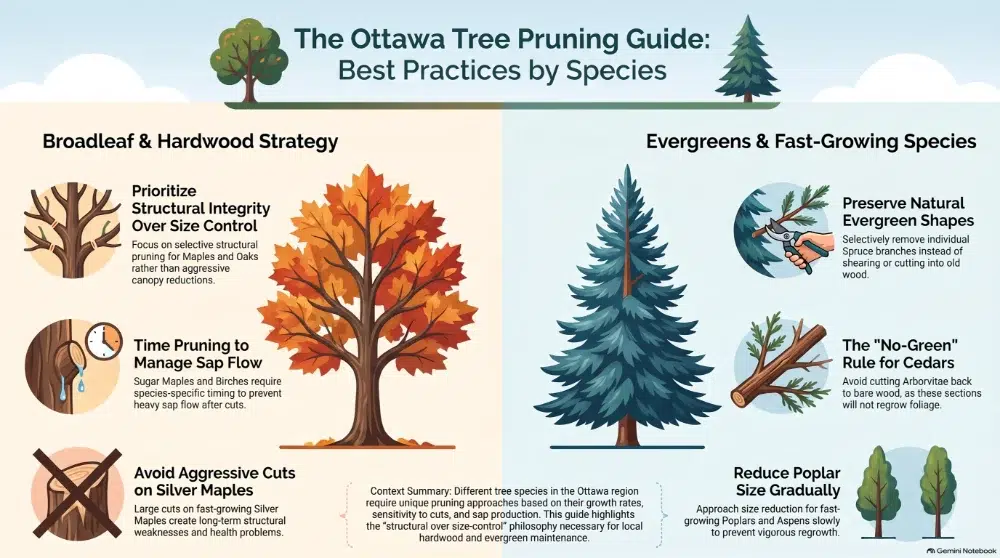
Different species respond differently to pruning, so there isn’t a universal tree canopy reduction rule that applies to every tree. Some species produce vigorous new growth after pruning, while others respond poorly to significant canopy loss.
The following illustration provides a general set of rules for common Ottawa-area trees:
What Is the One-Third Pruning Rule?
The 1/3 tree pruning rule is often confused with the 15–20% canopy guideline, but they address different things.
When reducing an individual branch, the general principle is to avoid removing more than about one-third of that branch’s length at once. This helps maintain enough foliage and branch structure to support healthy growth.
The distinction is important:
Neither rule means that you should automatically remove that amount. Good pruning starts with identifying what actually needs to be removed and taking as little as necessary.
Is Your Tree Due for a Prune?
Not sure whether your tree needs a light trim or more extensive pruning? SpinBlade can assess its structure and recommend the right amount of pruning for its condition, size, and species.
How to Estimate How Much You’re Removing
Knowing the general limit is helpful, but it can be difficult to judge what 15–20% of a tree’s canopy actually looks like. Before making cuts, step back and assess the whole tree so you can estimate how much live growth you’re planning to remove.
Look at the Canopy Before You Cut
Start by identifying the branches that actually need attention. Look for dead, damaged, crossing, or problematic branches rather than deciding to remove a certain amount of foliage first.
A useful approach is to mark or identify the branches you intend to remove, then step back and look at the tree again. If the planned work represents a substantial portion of the tree’s live canopy, it’s worth reconsidering whether all of those cuts are necessary.
Estimate the Live Canopy You’re Removing
You don’t need to calculate the canopy down to an exact percentage for routine homeowner pruning. Instead, use the 15–20% guideline as a visual checkpoint:
- Look at the entire live canopy before making any cuts.
- Identify the branches you want to remove and consider how much foliage they carry.
- Estimate the overall proportion of live growth those branches represent.
- Step back after each round of pruning to see how the tree’s shape and density have changed.
- Stop if you’re approaching a substantial reduction rather than continuing simply because more branches could be removed.
If you’re planning to remove a large portion of the canopy, the pruning technique being used also matters, since different techniques can require very different amounts of foliage to be removed. Professional assessment is preferable to estimating by eye, particularly when substantial canopy reduction is being considered.
Don’t Judge by Branch Count
Counting branches can give you a misleading idea of how much you’re removing. One large, leafy branch may account for considerably more canopy than several small twigs.
For example, removing ten small dead or lightly foliated branches is very different from removing ten large live limbs. The important consideration is how much living canopy you’re actually taking away, not simply how many cuts you make.
Practical tip: If you’re unsure whether you’ve already removed enough, stop cutting and reassess the tree from a distance. You can always remove another branch later; you can’t put a large limb back once it’s gone.
Signs You’ve Pruned Too Much
Even when the tree survives, over pruning a tree can create visible signs of stress. If you’ve recently removed a significant amount of live canopy, watch for changes in the following growing season.
These signs don’t necessarily mean the tree will die, but they can indicate that it has experienced more tree stress from over pruning than it can easily manage.
When to Call a Tree Care Professional
Knowing the general guidelines for how much to prune a tree can help with light maintenance, but some trees and pruning jobs are difficult to assess or safely handle without professional equipment. If you’re unsure how much to remove, especially when dealing with a mature or stressed tree, having the tree assessed first can help prevent unnecessary damage.
Consider Calling a Professional When:
Professional tree pruning can assess the tree’s overall structure and health before determining how much pruning is appropriate. This is especially important when the goal is reducing the tree’s size, since removing too much at once can create problems that are difficult to correct later.
Don’t Guess How Much to Cut
Pruning too little may leave a problem unresolved, while removing too much can stress the tree. SpinBlade can identify which branches actually need attention and develop a pruning approach around the tree’s long-term health.
Frequently Asked Questions
Still scratching your head? Here are quick answers to some of the most common questions people have.
In Short,
For routine pruning, keeping removal to around 15–20% of a tree’s live canopy in a single season is a useful conservative guideline, but it isn’t a target or a guarantee of safety. The tree’s species, age, health, previous work, and the reason for the work all need to be considered when determining how much to prune a tree.
When in doubt, focus on removing only what actually needs to go. Good pruning isn’t about cutting a certain percentage of the tree; it’s about making the necessary cuts while leaving enough healthy canopy and structure for the tree to continue growing well.