


Tree trimming and pruning are often treated as the same task, but they solve different problems on the same tree. When people ask about pruning vs trimming, they’re really asking which one fixes what’s actually wrong, trimming manages appearance, pruning manages health. Knowing the difference is what separates routine tree trimming and pruning from guesswork.
How Are Tree Trimming and Pruning Different?
Understanding how tree trimming and pruning differ starts with intent, not technique. The difference between tree trimming and pruning comes down to what each one is trying to fix: both involve cutting branches, but the goal, timing, and tools set them far enough apart that treating tree trimming and pruning as interchangeable can leave real structural problems unaddressed while the tree still looks tidy. The table below lays out exactly how tree trimming vs pruning compare, side by side.
| Aspect | Tree Pruning | Tree Trimming |
|---|---|---|
| Primary Goal | Health, structure, safety | Appearance, size control |
| What’s Removed | Dead, diseased, or crossing branches | Overgrowth, uneven ends |
| Timing | Dormant season (late fall–early spring) | Growing season, or as needed |
| Tools | Loppers, pruning saws, hand pruners | Hedge shears, pole saws |
| Frequency | Every few years for established trees | As needed, often 1–2x per year |
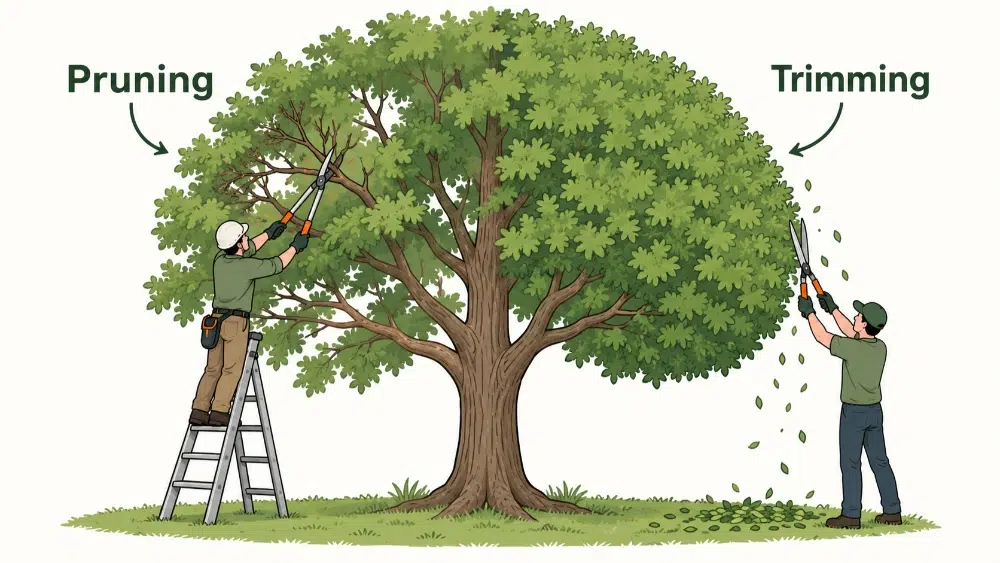
Tree Pruning
Tree pruning is the more technical of the two practices, since a poorly placed cut can do more harm than leaving the branch alone. It’s guided by the tree’s biology rather than its appearance, which is why pruning follows a stricter set of standards than trimming trees typically requires.
What Is Tree Pruning?
Tree pruning is the selective removal of specific branches to improve a tree’s health and structural integrity. That’s the tree pruning definition in short — the tree pruning meaning goes a layer deeper, since it’s about correcting problems beneath the surface rather than shaping what’s visible. For the full breakdown, see our guide to tree pruning.
When to Prune
Timing matters more for pruning than almost anything else in tree care, since cutting at the wrong point in the season can stress the tree or invite disease.
Tree Pruning Techniques
Pruning techniques are chosen based on what the tree actually needs, not a fixed schedule. Reduction cuts shorten a branch back to a healthy bud to control size without leaving a stub, while crown cleaning removes dead or diseased branches placed just outside the branch collar, following ANSI A300 cut-placement standards to help the tree seal the wound and limit decay.
As a rule, never remove more than 25–30% of a tree’s canopy in a single pruning session, taking more than that stresses the tree and can trigger weak, poorly attached regrowth. For structural work at a larger scale, our guides to crown reduction and crown thinning cover those techniques in full, both are pruning, not trimming, since they’re driven by the tree’s health rather than its shape.
Not Sure If Your Tree Needs Trimming or Pruning?
SpinBlade’s Cole Horton, a Certified Utility Arborist, will assess your tree and tell you exactly which one it needs, no guesswork. Get a free quote and let a CUA make the call.
Tree Trimming
Tree trimming is less technical than pruning, but that doesn’t make it optional, a tree left untrimmed for years can become dense enough to block light and trap moisture. It’s the more frequent of the two practices, and the one most homeowners handle themselves.
What Is Tree Trimming?
Tree trimming is the process of cutting back overgrown branches to manage a tree’s size and shape. For the full process and tool list, see our guide to tree trimming.
When to Trim
Trimming has more flexibility than pruning, but a few conditions still make timing worth planning around.
Tree Trimming Techniques
Trimming techniques focus on shape rather than internal health. Heading cuts shorten branches back to a bud or lateral branch to control size and direction, while crown raising removes lower limbs to improve clearance beneath the canopy.
As a general guide, hand pruners handle branches up to about 1.5 inches thick, while anything thicker calls for loppers or a pole saw to get a clean cut instead of tearing the bark. For trees maintained at a fixed height and shape year after year, our guide to tree pollarding covers that specialized trimming technique in depth.
Signs You Need Tree Trimming or Pruning
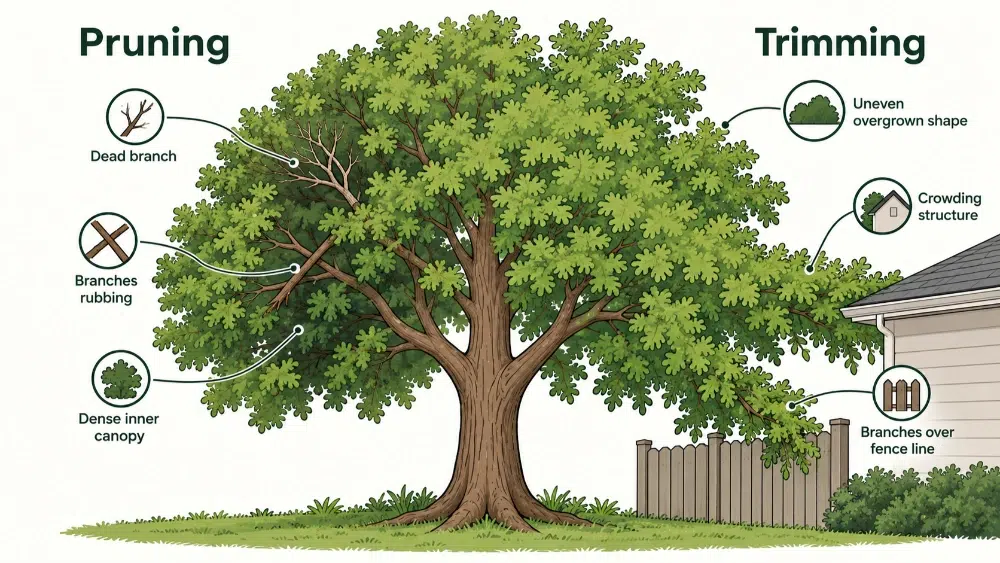
Trim or prune, which does your tree actually need? The clearest way to answer that is to look at what’s wrong with it rather than guessing based on how long it’s been since the last visit, since health-related issues point to pruning and appearance-related issues point to trimming.
Signs You Need Pruning:
- Dead, broken, or diseased branches anywhere in the canopy — these are the branches most likely to fail in a storm or spread disease to healthy wood
- Branches crossing or rubbing against each other, which wears through bark over time and creates an entry point for pests
- A canopy so dense that light barely reaches the interior, starving the lower and inner branches of what they need to stay healthy
Signs You Need Trimming:
- Branches extending over a roofline, walkway, or fence, where they’re more a nuisance than a hazard
- An uneven or overgrown silhouette that affects looks rather than the tree’s underlying health
- Growth that’s outpaced the space it’s planted in, crowding a fence line, driveway, or neighboring plant
DIY vs. Professional Tree Trimming and Pruning
Deciding between DIY and professional tree trimming and pruning comes down to weighing cost savings against real risk, both to you and to the tree. The table below breaks down what each option actually gets you.
| Pros | Cons | |
|---|---|---|
| DIY | Costs less, works fine for small or low branches, flexible on timing | No training in structural cuts, higher injury risk from ladders or power tools, a bad cut can weaken the tree for years |
| Professional | ISA-certified expertise, insured against property damage, equipped for tall trees and structural corrections | Higher upfront cost, requires scheduling around availability |
SpinBlade’s tree trimming and pruning work is led by Cole Horton, a Certified Utility Arborist (CUA) who trained through a 4-year apprenticeship with the Ontario College of Trades, following ISA-certified standards on every job.
For any tree over 15 feet, near power lines, or requiring structural correction, professional tree trimming and pruning is the safer call than a DIY attempt.
Frequently Asked Questions
Conclusion
Tree trimming and pruning both keep a tree healthy and attractive, but they solve different problems and follow different timelines. With tree trimming and pruning compared side by side, the choice for your tree comes down to what it actually needs, pruning corrects what’s wrong beneath the surface, while trimming manages what’s visible from the yard.
If you’re not sure which one applies, that uncertainty is exactly when professional tree trimming and pruning is worth the call.
Not Sure If Your Tree Needs Trimming or Pruning?
SpinBlade’s Cole Horton, a Certified Utility Arborist, will assess your tree and tell you exactly which one it needs, no guesswork. Get a free quote and let a CUA make the call.


