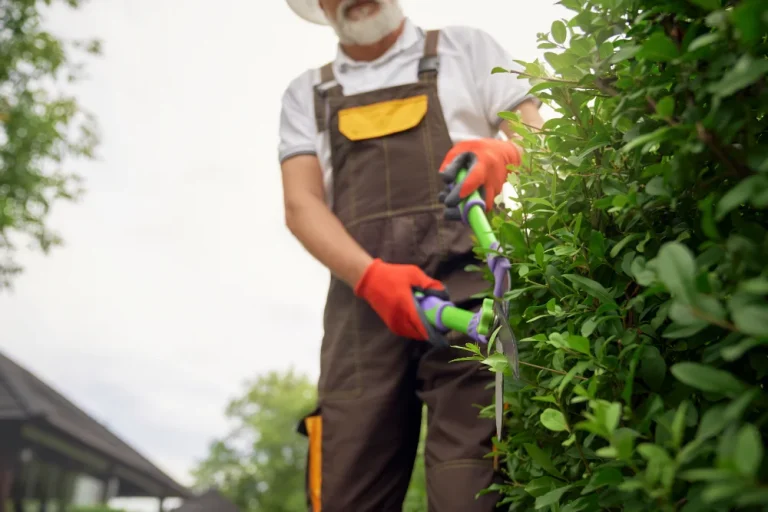
Tree pruning is one of the most misunderstood tasks in tree care, often mistaken for trimming, sometimes skipped entirely, and occasionally done badly enough to cause real, lasting damage. This tree pruning guide covers what pruning actually is, when it’s needed, how professionals do it, and the standards that separate a correct cut from a harmful one.
What Is Tree Pruning?
Tree pruning is the selective removal of specific branches to improve a tree’s health, structure, and safety. That’s the short version of what it means to prune a tree — the purpose of pruning trees goes a layer deeper, since it’s about correcting problems beneath the surface rather than simply shaping what’s visible.
Unlike tree trimming, pruning leaves the root system fully intact and focuses on the tree’s long-term structure rather than its outward appearance. For a breakdown of how the two practices differ, see our guide to tree trimming and pruning.
Purpose and Timing of Pruning
Knowing tree pruning inside and out means understanding not just how it’s done, but why it’s done, when it’s needed, and when it’s better left alone.
Why Trees Are Pruned
Crossing or rubbing branches wear through bark over time, creating an entry point for pests and disease — removing one before that happens is far cheaper than treating the infection afterward. A canopy left too dense starves the interior and lower branches of light, which is what eventually kills them off from the inside out. See our full breakdown of the benefits of tree pruning for the complete picture.
Hazardous branches are a different case entirely: a cracked or overhanging limb is a liability the moment it’s noticed, not something to schedule around a “good time of year.”
When Pruning Is Needed
These are the clearest signs your tree needs pruning right now, not eventually.
- Dead, broken, or diseased branches anywhere in the canopy
- Branches crossing or rubbing against each other
- A canopy so dense that light barely reaches the interior
- Any limb overhanging a structure, walkway, or power line
When Pruning Should Be Avoided
A few conditions make pruning worse than doing nothing at all, at least temporarily.
- High sap flow periods, like maple in early spring, which can cause excessive bleeding
- Extreme heat or drought stress, when the tree has little energy to recover
- Right before a hard freeze, since a fresh cut won’t have time to callous over
How Often Trees Should Be Pruned
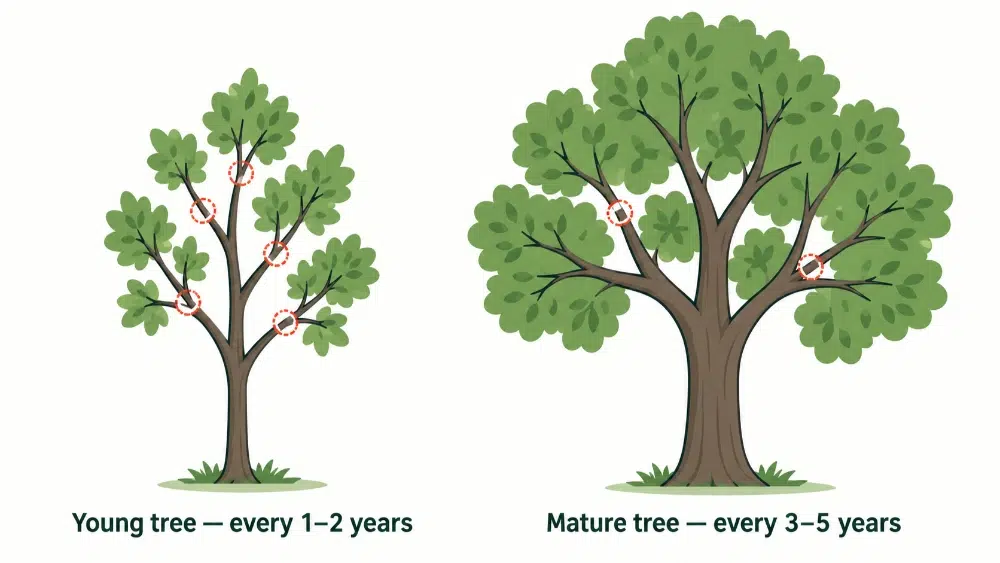
Frequency depends more on the tree’s age, species, and condition than on any fixed schedule. Young trees benefit from light structural pruning every 1–2 years to establish good branch spacing early, while mature, healthy trees generally only need attention every 3–5 years once that structure is set.
Fast-growing or weak-wooded species; like willow or silver maple, need more frequent checks than slow-growing hardwoods like oak, since they’re more prone to developing weak or crossing branches between visits. A tree near a structure, power line, or walkway also warrants more frequent inspection regardless of species, since the safety stakes of a missed hazard branch are higher there than in an open yard.
Do you Need Tree Pruning?
SpinBlade prunes to ANSI A300 standards on every cut, no flush cuts, no topping, no guesswork on timing. Get a free assessment and get it right the first time.
How Pruning Is Actually Done
Professional tree pruning follows a defined process, uses named techniques for specific problems, and depends on the right tools and standards to get right.
The Pruning Process, Step by Step
Every job follows roughly the same tree pruning process, regardless of tree size or species.
- Assess the tree for structural issues, disease, and hazard branches before making a single cut
- Identify the technique that fits the problem — thinning, reduction, or deadwooding, depending on what’s actually wrong
- Start with the largest problem branches first, working from the top of the canopy down
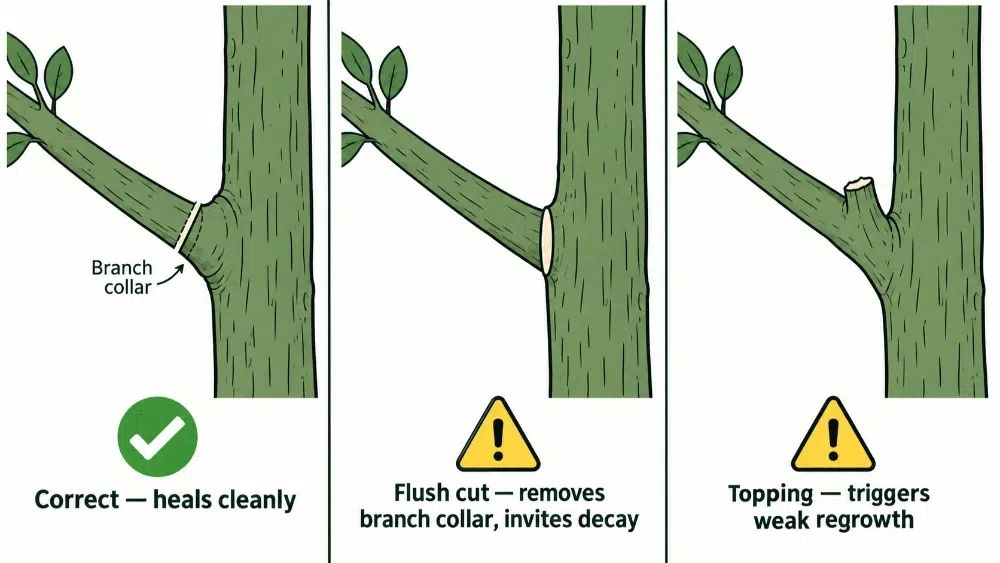
- Make each cut just outside the branch collar, following ANSI A300 placement standards so the wound seals properly
- Step back periodically to check the tree’s overall shape and balance as work progresses
- Remove no more than 25% of live canopy in a single session to avoid stressing the tree, cutting far more than this is often how tree topping happens by accident, which causes lasting damage
- Clean up and dispose of debris, checking the site for anything left that could pose a hazard
- Document the work, especially for larger trees, so future pruning follows a consistent plan
Tree Pruning Techniques
Different problems call for different techniques, and knowing the right one is as important as making a clean cut. Our full tree pruning techniques guide breaks down each method in detail, here’s a quick summary:
- Crown thinning removes select interior branches to improve light and airflow
- Crown reduction shortens the overall size of the canopy without changing its natural shape
- Deadwooding removes dead or dying branches to eliminate hazards and stop pests from moving in.
- Structural pruning builds a strong branch framework on young trees before problems can develop
- Pollarding maintains a tree at a fixed height and shape year after year
- Espalier trains a tree to grow flat against a wall or frame, mostly for ornamental or space-saving purposes.
Tools and Equipment You’ll Need
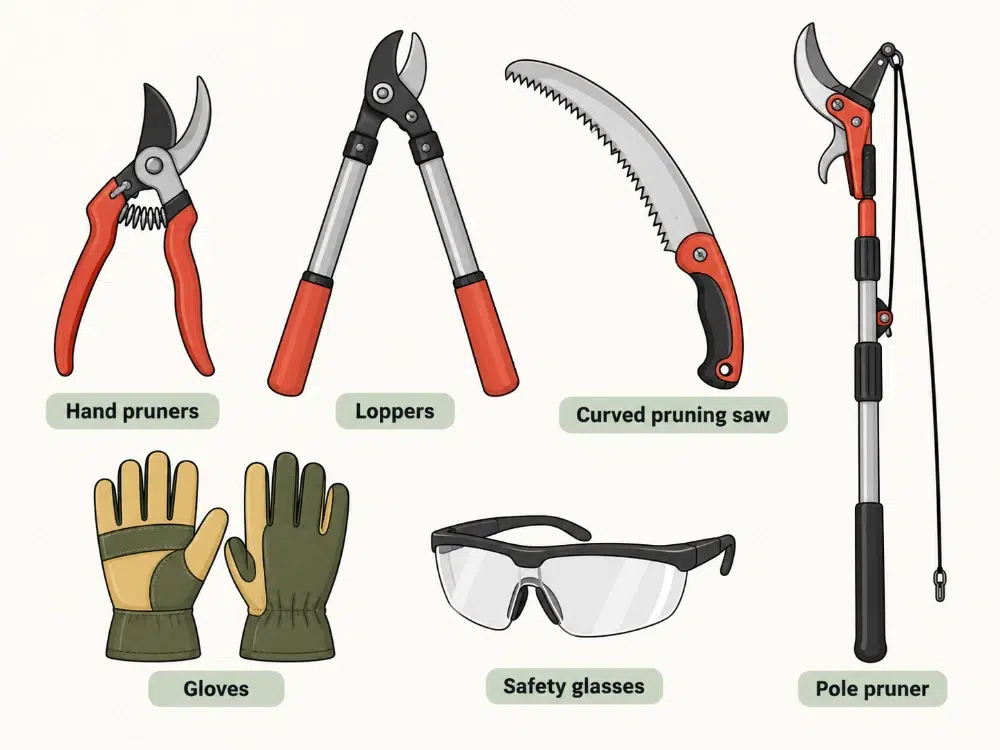
The right tree pruning tools depend entirely on branch size, and using the wrong one is a common source of damage. See our full guide to tree pruning tools for more detail on each.
| Tool | Best For | Note |
|---|---|---|
| Hand pruners | Branches up to ¾ inch thick | Bypass style gives a cleaner cut than anvil style |
| Loppers | Branches up to 2 inches thick | Longer handles add leverage without forcing the cut |
| Pruning saw | Branches over 2 inches thick | A dull blade tears bark instead of cutting cleanly |
| Pole pruner | High branches from the ground | Reduces the need for a ladder on smaller jobs |
Beyond the cutting tools themselves, basic PPE, gloves and eye protection at minimum should be standard on every job, regardless of tree size.
Standards and Regulations
Tree pruning standards in North America are governed by ANSI A300, which sets out correct cut placement, wound response, and overall pruning practice. Following it is what separates a cut that heals cleanly from one that invites decay.
Locally, Ottawa’s Tree Protection By-law doesn’t require a permit to prune trees on private property, but it does expect work to follow good arboricultural practice, which is exactly what ANSI A300 defines.
Mistakes That Should Be Avoided in Tree Pruning
The most damaging pruning mistakes aren’t usually about skill, they’re shortcuts. Flush cuts, where a branch is cut right at the trunk instead of just outside the branch collar, remove the exact tissue a tree needs to seal the wound, leaving it open to decay for years instead of healing over in one season. Topping, cutting main branches back to stubs to quickly reduce a tree’s height triggers weak, poorly attached regrowth that’s more likely to fail in a storm than the branches it replaced.
Removing more than 25% of live canopy in a single session is another common overreach: it looks like thorough work, but it pushes the tree into stress and survival mode instead of healthy growth. Timing mistakes cause the same kind of damage in a different way cutting oak during its April–November risk window, or maple while sap is actively rising, turns a routine job into an avoidable disease or stress event. Even something as simple as a dull or unsanitized blade can carry disease from one tree to the next, undoing whatever good the cut itself was meant to do.
Best Time to Prune Trees by Species
Timing isn’t one-size-fits-all, and knowing when to prune trees correctly depends on species as much as season. Per the Morton Arboretum’s guide to pruning trees, most species do best during dormancy, but the table below breaks down real exceptions by species, since the “right” time changes significantly from one tree to the next. For fruit-bearing species specifically, see our full guide to pruning fruit trees.
| Species | Best Time | Reason |
|---|---|---|
| Maple | Mid-to-late summer or winter | Avoids the high sap flow of early spring |
| Oak | Outside April–November | Avoids the season when sap beetles spread oak wilt, per Canada’s Invasive Species Centre |
| Cherry / Flowering | Immediately after bloom | Protects next season’s flowers |
| Conifers | Late winter, before new growth | Limits resin loss and supports fresh spring growth |
Oak deserves special attention here: oak wilt was first confirmed in Ontario in 2023, and pruning outside the April–November window specifically reduces the risk of introducing the fungus through a fresh cut.
DIY or Professional?
Small, low branches are reasonable to prune yourself with basic tools, but cuts that affect a tree’s structure carry real risk if placed incorrectly. Avoiding common tree pruning mistakes, like cutting too close to the trunk or removing too much canopy at once, is exactly why hiring a certified professional matters for anything beyond the basics.
| Pros | Cons | |
|---|---|---|
| DIY | Costs less, fine for small or low branches | No training in structural cuts, higher injury risk, a bad cut can cause lasting harm |
| Professional | ISA-certified expertise, insured, equipped for tall or structural work | Higher upfront cost, requires scheduling |
SpinBlade’s tree pruning services work is led by Cole Horton, a Certified Utility Arborist (CUA) who trained through a 4-year apprenticeship with the Ontario College of Trades, following ISA-certified standards on every job. For any tree over 15 feet, near power lines, or requiring structural correction, professional tree pruning is the safer call than a DIY attempt.
Tree pruning cost in Ottawa typically ranges from $175 to $1,267, depending on tree size, condition, and accessibility. See our full guide to how much it costs to prune a tree for a detailed breakdown by tree size.
Frequently Asked Questions
Conclusion
Tree pruning done correctly protects a tree’s health, structure, and safety for years, while pruning done incorrectly can cause damage that takes just as long to recover from. Whether it’s a simple deadwooding job or full structural correction, following the right technique, timing, and standard makes the difference. If your tree needs more than a small cut, a professional assessment is the safest next step.
Do you Need Tree Pruning?
SpinBlade prunes to ANSI A300 standards on every cut, no flush cuts, no topping, no guesswork on timing. Get a free assessment and get it right the first time.