A late frost, a wet spring, compacted soil, even last summer’s drought can all leave marks on your tree that look suspiciously like disease. The challenge is that many types of tree diseases overlap visually with normal stress responses, especially in Canadian climates where weather swings are part of the deal. This article steps back from individual diagnoses and instead looks at how tree diseases are broadly categorized, what parts of the tree they tend to affect first, and how those patterns help separate temporary stress from genuine health problems.
How Tree Diseases Are Commonly Grouped
Tree health problems are often discussed as long lists of pathogens, but that approach isn’t especially helpful for real‑world observation. Broadly speaking, diseases can be grouped in two overlapping ways. One is by the part of the tree they affect first, such as foliage, vascular tissue, or roots. The other is by cause, including fungal, bacterial, viral, or parasitic organisms. Many diseases fall into more than one category, which is why symptoms alone rarely tell the full story.
In Canada, environmental stress plays an outsized role in how these diseases develop. Freeze‑thaw cycles, prolonged spring moisture, compacted urban soils, and drought periods can all weaken trees and make them more susceptible, or create symptoms that closely resemble disease even when no pathogen is present.
Common ways types of tree diseases are categorized
Understanding these groupings makes it easier to interpret symptoms later, especially when using a tree disease identification guide alongside visual inspection.
| Grouping Method | What It Helps Explain |
|---|---|
| By affected tree part | Where symptoms appear first and how visible they are |
| By underlying cause | How the disease spreads and progresses |
| By speed of decline | Whether change is cosmetic, gradual, or severe |

Diseases That Show Up First in Leaves & Needles
Leaf and needle problems are usually the first thing people notice, which makes this category one of the most visible types of tree diseases. Changes in foliage often appear early in the growing season and can look dramatic, even when the long‑term impact is limited. In other cases, leaf symptoms are the first warning sign of a deeper issue.
Common Leaf & Needle Disease Patterns
Foliage diseases tend to follow a few recognizable patterns rather than random damage. Spotting these patterns helps narrow down possibilities without jumping to conclusions.
Typical symptoms include spotting or blotching, powdery or fuzzy coatings, distorted or curled leaves, and premature yellowing or drop. Needle diseases may show banding, browning from the tip inward, or thinning over time. While these signs are often linked to fungal or viral causes, environmental stress can create nearly identical effects.
Examples of Leaf & Needle Diseases
The following conditions illustrate how leaf‑focused diseases usually behave, without covering every variation or species‑specific detail.
 1. Anthracnose
 2. Powdery Mildew
 3. Cedar Apple Rust
 4. Leaf Curl
 5. Needle Cast Disease
 6. Mosaic Virus
- Anthracnose commonly causes irregular brown or black blotches along leaf veins and edges, often appearing during cool, wet spring weather. It can look severe but is frequently more cosmetic than lethal when trees are otherwise healthy.
- Relevance to Canadian Species: Very common on maple, ash, sycamore.
- Could Be Mistaken For: Frost damage, normal leaf drop, insect feeding.
- Powdery Mildew appears as a white or gray coating on leaf surfaces, particularly in shaded or poorly ventilated areas. While it rarely kills trees, repeated infections can weaken growth over time.
- Relevance to Canadian Species: Common on ornamentals, some shade trees.
- Could Be Mistaken For: Dust, early fungal spore deposits, environmental humidity.
- Cedar Apple Rust creates bright yellow or orange spots on leaves and requires two different host plants to complete its life cycle. Its appearance is seasonal and closely tied to moisture conditions.
- Relevance to Canadian Species: Very common where junipers and apples coexist.
- Could Be Mistaken For: Nutrient deficiency spots, minor insect damage.
- Leaf Curl (Taphrina) causes leaves to thicken, twist, or distort early in the season, often before they fully expand. Once symptoms appear, treatment options are usually limited until the following year.
- Relevance to Canadian Species: Common on ornamental cherries, plums, peaches.
- Could Be Mistaken For: Frost damage, chemical injury.
- Needle Cast Disease cause browning and premature shedding of needles, often starting on lower branches and progressing upward. Infected needles may develop spots, streaks, or general discoloration depending on the specific fungal species involved.
- Relevance to Canadian Species: Common on spruce, pine, and fir in home landscapes, urban plantings, and backyard windbreaks.
- Could Be Mistaken For: Drought stress, winter burn, natural needle drop from older foliage.
- Mosaic Virus leads to mottled, patchy coloration across leaves, giving them a marbled appearance. Viral diseases tend to persist long‑term and are managed through overall tree health rather than direct cures.
- Relevance to Canadian Species: Less common, mainly maples
- Could Be Mistaken For: Nutrient deficiency, uneven sunlight exposure.
Many of these issues overlap visually, which is why leaf symptoms alone rarely confirm a diagnosis. They are best viewed as signals that further observation is needed rather than immediate proof of decline.
Tree health isn’t just about appearance.
Diseases that weaken structure can create safety risks over time. If you’re seeing ongoing dieback or canopy thinning, Spinblade’s team can help evaluate risk and recommend next steps.
Diseases That Affect Branches, Trunks & Vascular Systems
Problems that involve branches, bark, or internal transport systems tend to be more serious than leaf-only issues. Even when symptoms appear on leaves, the underlying failure in this category is happening inside the tree’s vascular tissue rather than in the foliage itself. These types of tree diseases interfere with how water and nutrients move through the tree, meaning damage often progresses even when foliage still looks relatively normal.
Structural & Vascular Warning Patterns
Diseases in this category usually show up as dieback at branch tips, sunken or cracked areas of bark, oozing wounds, or sudden wilting that doesn’t match weather conditions. Because these symptoms affect the tree’s core systems, they are commonly associated with long-term decline rather than cosmetic damage. This is where many classic signs of a dying tree begin to appear.
Examples of Trunk & Vascular Diseases
The following diseases illustrate how internal damage presents externally, without diving into species-specific diagnosis.
 1. Dutch Elm Disease
 2. Fire Blight
 3. Bacterial Leaf Scorch
 4. Crown Gall
- Dutch Elm Disease blocks water movement inside the tree, leading to rapid wilting and browning of leaves on individual branches before spreading throughout the canopy. Once established, progression is often aggressive.
- Relevance to Canadian Species: Very common in Ontario and Quebec.
- Could Be Mistaken For: Drought stress, branch dieback from insects.
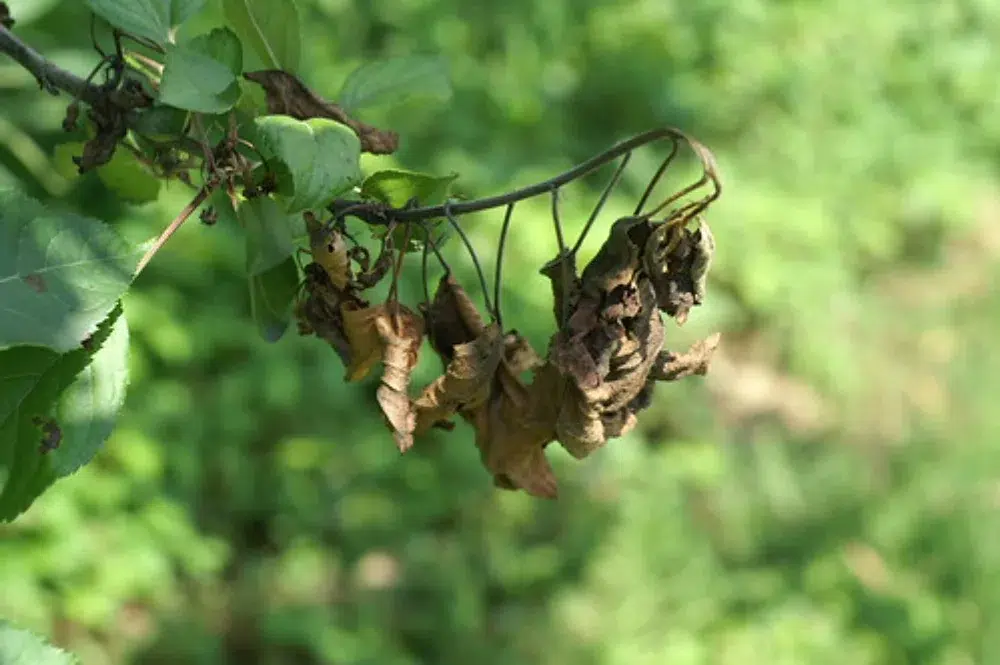
- Fire Blight causes blackened, scorched-looking shoots and branches, most commonly on flowering trees. Infections spread quickly during warm, wet conditions and can move through pruning wounds.
- Relevance to Canadian Species: Very common in apple, pear, hawthorn.
- Could Be Mistaken For: Frost damage, sunscald, environmental scorch.
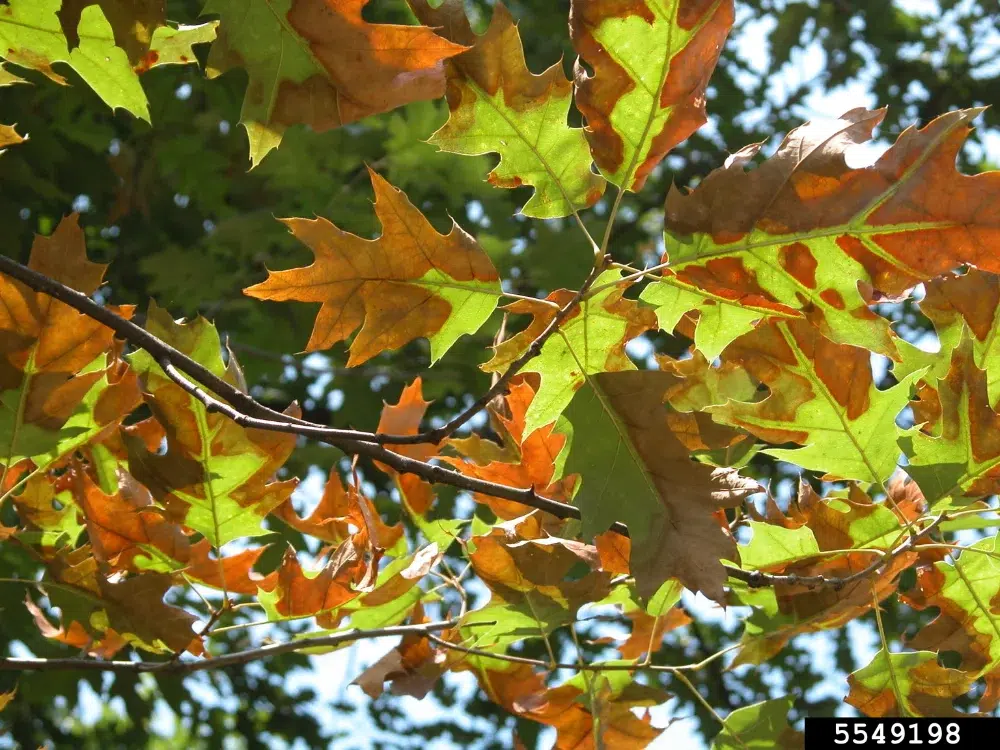
- Bacterial Leaf Scorch leads to browning along leaf edges combined with gradual thinning of the canopy over multiple seasons. Symptoms often worsen during hot or dry periods, making decline appear intermittent.
- Relevance to Canadian Species: Common on oak, maple, elm.
- Could Be Mistaken For: Drought, high heat, nutrient deficiency.
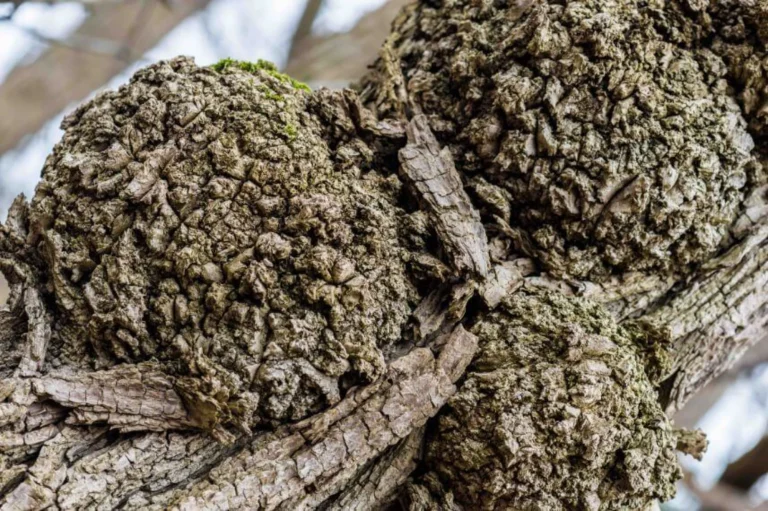
- Crown Gall forms rough, tumor-like growths near the base of the trunk or along roots and lower branches. While not always fatal, these growths disrupt nutrient flow and weaken structural stability over time.
- Relevance to Canadian Species: Common on ornamentals and fruit trees.
- Could Be Mistaken For: Burls, old pruning scars.
- Cytospora Canker causes sunken, discolored areas (cankers) on branches and trunks, often accompanied by oozing sap. Infected branches may die back gradually, and the disease tends to worsen on trees already stressed by drought, poor soil, or mechanical injury.
- Relevance to Canadian Species: Common on spruce, poplar, and willow, especially in Ontario.
- Could Be Mistaken For: Burls, old pruning scars.
When symptoms overlap, guessing can do more harm than good.
If your tree shows multiple warning signs or declines quickly, Spinblade’s arborists can help confirm the cause and prevent unnecessary damage.
Diseases That Begin Below Ground
Roots respond strongly to soil conditions, drainage, compaction, and oxygen availability. In Canadian landscapes, heavy clay soils, prolonged spring moisture, and freeze-thaw cycles can all stress root systems and create ideal conditions for disease development. By the time symptoms appear above ground, significant decline may already be underway.
Common Above-Ground Clues of Root Problems
Although the damage begins below ground, root diseases eventually create recognizable patterns in the visible parts of the tree. These signs tend to be subtle at first and worsen over multiple growing seasons rather than appearing all at once.
Typical indicators include reduced annual growth, smaller or dull-colored leaves, thinning canopies, delayed leaf-out in spring, and branch dieback that doesn’t follow a clear directional pattern. Because these symptoms are nonspecific, root diseases are frequently mistaken for drought stress, nutrient deficiency, or normal aging.
Examples of Root Diseases
The following diseases illustrate how below-ground problems typically affect trees, without covering every species-specific variation.
 1. Root rot
 2. Phytophthora Root Disease
 3. Armillaria Root Disease
- Root Rot refers to a group of fungal diseases that cause decay of fine and structural roots, usually in poorly drained or compacted soils. As roots deteriorate, trees struggle to absorb water and nutrients even when soil moisture is adequate.
- Relevance to Canadian Species: Very common in poorly drained or compacted soils.
- Could Be Mistaken For: Drought stress, poor soil fertility.
- Phytophthora Root Disease thrives in saturated soils and spreads through water movement in the soil. It commonly affects landscape and forest trees, causing gradual decline, canopy thinning, and increased susceptibility to secondary stressors.
- Relevance to Canadian Species: Very common in wet soils and ornamentals.
- Could Be Mistaken For: Water stress, seasonal dieback.
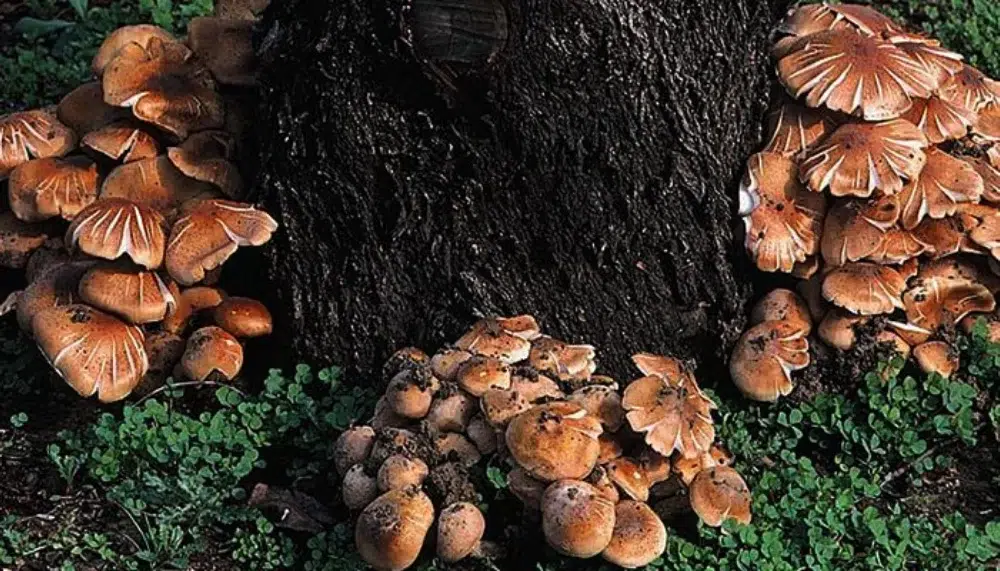
- Armillaria Root Disease attacks roots and the root collar, weakening both nutrient transport and structural support. Infected trees may decline slowly or fail suddenly due to compromised anchoring roots, particularly when already stressed. Can cause sudden tree fall; mushrooms may appear at base.
- Relevance to Canadian Species: Common in forests, landscapes in Ontario
- Could Be Mistaken For: Old age, environmental stress.
Parasitic Diseases
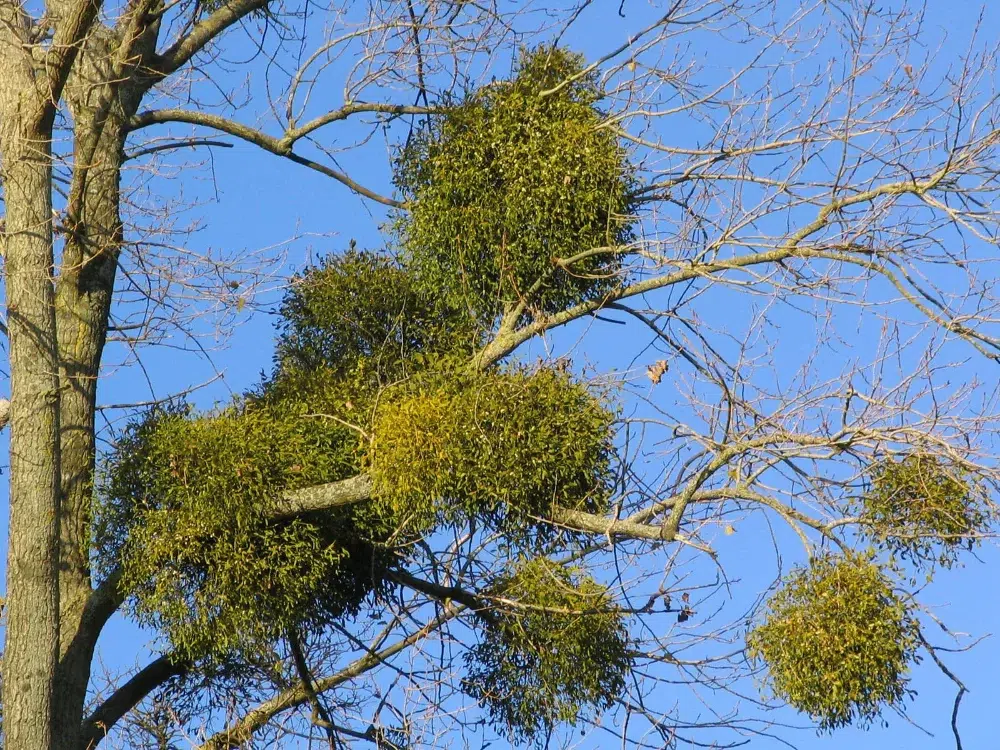
Parasitic plants extract water and nutrients directly from their host trees, gradually weakening them over time. In Canadian landscapes, mistletoe is the most common parasitic species affecting deciduous trees, and infestations can reduce vigor, increase branch dieback, and sometimes contribute to structural failure if heavy or long-standing. Because parasitic plants grow in clusters within the canopy, their impact is often overlooked until visible decline appears.
Common Above-Ground Clues of Parasitic Infestation
Although the “infection” occurs above ground, the damage may take years to become obvious. Infected trees often display:
- Thinning canopy or stunted growth
- Branch dieback below the parasitic clusters
- Irregular growth patterns around infection sites
Because these symptoms are nonspecific, homeowners may mistake mistletoe damage for pruning injury, environmental stress, or normal branch dieback.
Example of Parasitic Disease
- Mistletoe grows in clusters on branches and sometimes at the base of small twigs. While it doesn’t directly kill the tree, it competes for water and nutrients, slowly reducing the tree’s vigor and increasing vulnerability to other stressors.
- Relevance to Canadian Species: Very common on maples, poplars, and other deciduous trees in eastern Ontario and across Canada.
- Could Be Mistaken For: Normal branch dieback, pruning scars, or minor mechanical damage, especially when clusters are small or young.
Problems that start below ground or inside the trunk are easy to miss.
If decline seems gradual, uneven, or unrelated to weather, Spinblade can assess hidden issues before they become irreversible.
FAQ: Types of Tree Diseases
Here are common questions homeowners have when trying to identify tree problems:
In Short,
Understanding the types of tree diseases helps homeowners recognize problems early and prioritize action. Leaf spots, branch dieback, cankers, root decline, and parasitic growths may look different depending on species and severity, but patterns often repeat. Use symptom descriptions to narrow possibilities, consider your local Ontario environment, and consult professionals for serious or widespread issues. By combining observation with knowledge, you can protect tree health, prevent structural failure, and maintain the beauty of your landscape.